Whether you’re preparing land for a commercial development, creating more usable space on a sloped property, or protecting your investment from erosion, a large scale retaining wall is often one of the most important components of the project. While many people think retaining walls are simply stacks of blocks or rock holding back soil, the reality is much more involved. The success of any retaining wall starts long before the first block or boulder is placed.
At Fraser Valley Contracting, we’ve worked on excavation, site grading, and retaining wall projects throughout Chilliwack and the Fraser Valley. We know that every property presents its own challenges, from steep hillsides and poor drainage to unstable soils and limited access. A properly planned retaining wall doesn’t just solve today’s problem. It helps protect your property for decades while creating safe, functional, and attractive outdoor spaces.
In this guide, we’ll explain how large scale retaining walls are built, why excavation and site leveling are critical, and what property owners should know before starting their project.
What Is a Large Scale Retaining Wall?
A retaining wall is a structure designed to hold back soil where there is a change in elevation. Unlike decorative garden walls, large scale retaining walls are built to manage significant loads and stabilize large areas of land. They are commonly used for commercial developments, industrial sites, residential subdivisions, agricultural properties, and large residential lots with steep terrain.
Large retaining walls serve several purposes, including:
- Stabilizing slopes
- Preventing soil erosion
- Creating level building pads
- Expanding usable outdoor space
- Supporting roads, driveways, and parking areas
- Improving drainage and stormwater management
When designed and constructed properly, a retaining wall becomes an essential part of the property’s infrastructure rather than simply a landscaping feature.
Every Successful Retaining Wall Starts with Excavation
One of the biggest misconceptions about retaining walls is that construction begins once materials arrive on site. In reality, excavation is often the most important phase of the entire project.
Before construction begins, the site must be carefully evaluated to understand existing grades, soil conditions, drainage patterns, and access for equipment. The excavation process creates a stable foundation that supports the wall while allowing proper drainage behind it.
Without proper excavation, even the strongest retaining wall materials can eventually fail due to settling, shifting, or excessive water pressure.
At Fraser Valley Contracting, our excavation services include:
- Site clearing
- Earthmoving
- Foundation excavation
- Site grading
- Trenching for drainage systems
- Removal of unsuitable soils
- Preparation of engineered base materials
Having the right equipment for both tight residential spaces and large commercial sites allows us to complete excavation efficiently while maintaining precision throughout the project.
Why Site Leveling Matters
Many retaining wall projects involve much more than simply supporting a hillside. Often, the goal is to transform uneven land into usable space.
Site leveling creates flat areas for future construction, parking lots, outdoor living spaces, equipment yards, or landscaping. Without proper grading, water may collect in low areas, increase pressure behind the retaining wall, or create long-term drainage issues.
Proper site leveling helps:
- Improve drainage
- Reduce erosion
- Create stable building surfaces
- Maximize usable property
- Improve accessibility
- Support future construction
For commercial projects, proper grading also helps meet municipal design requirements while improving vehicle access and pedestrian safety.
Understanding Soil Conditions
No two properties are exactly alike. The type of soil beneath the surface has a major impact on how a retaining wall should be designed and constructed.
Clay soils, for example, tend to retain water and expand during wet conditions, placing additional pressure on retaining walls. Sandy soils drain more freely but may require additional stabilization depending on site conditions.
Rocky terrain presents its own challenges, often requiring specialized excavation equipment to prepare a proper foundation.
Understanding soil conditions before construction begins allows the project to move forward with fewer surprises and helps ensure the retaining wall performs as intended over the long term.
Drainage Is Just as Important as the Wall Itself
Water is one of the leading causes of retaining wall failure.
As water accumulates behind a wall, hydrostatic pressure builds against the structure. Even a well-built retaining wall can experience excessive stress if water has nowhere to escape.
Proper drainage systems are essential and may include:
- Perforated drainage pipe
- Drain rock
- Filter fabric
- Surface drainage control
- Grading that directs water away from the wall
Managing water effectively reduces pressure on the wall while protecting surrounding landscaping and nearby structures.
Because Fraser Valley Contracting also installs drainage systems and performs site drainage correction, we understand how excavation, grading, drainage, and retaining walls all work together as one complete solution.
Choosing the Right Retaining Wall System
Every retaining wall project is different, and selecting the right construction method depends on several factors, including wall height, soil conditions, available space, aesthetics, and engineering requirements.
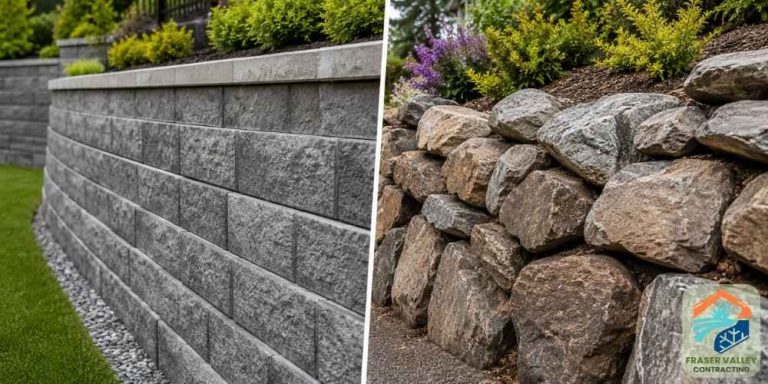
Some of the most common options include rock retaining walls and engineered block retaining walls.
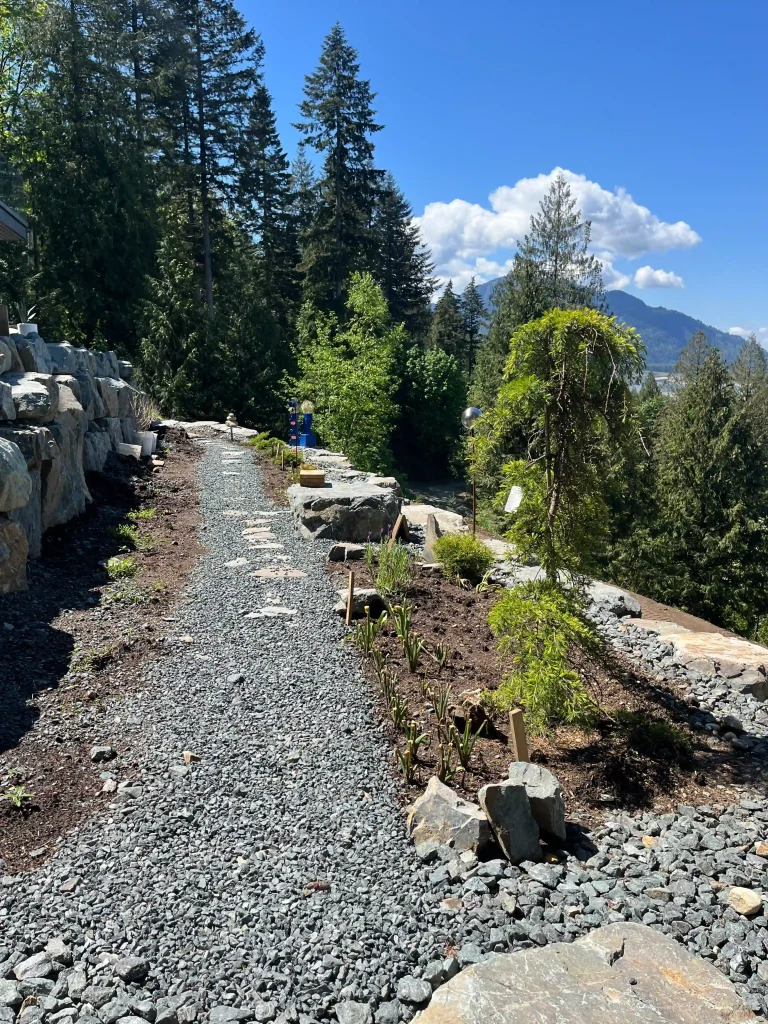
Natural rock retaining walls provide a durable, timeless appearance that blends well with many Fraser Valley landscapes. Large boulders create excellent structural stability while adding a natural aesthetic to residential and commercial properties.
Engineered block retaining walls offer clean lines and consistent performance. Many commercial developments prefer these systems because they provide predictable installation and are engineered for significant structural loads.
The best choice depends on the specific project goals rather than simply appearance alone.
The Construction Process
While every retaining wall project is unique, the overall construction process generally follows several important stages.
The first step involves evaluating the property, reviewing grades, and identifying drainage requirements.
Next comes excavation, where unsuitable soils are removed and the foundation is prepared.
A compacted base is then installed to create a stable platform capable of supporting the wall.
Once the foundation is complete, construction of the retaining wall begins. Depending on the project, this may involve placing large natural rock, engineered retaining wall blocks, or other structural systems.
Drainage materials are installed behind the wall before backfilling takes place in carefully compacted layers.
Finally, the surrounding site is graded, finished, and prepared for landscaping or future construction.
Each stage plays a critical role in the overall performance of the finished retaining wall.
Common Problems That Can Be Prevented
Many retaining wall failures are caused by shortcuts during construction rather than the wall materials themselves.
Some of the most common issues include:
- Inadequate excavation
- Poor foundation preparation
- Insufficient drainage
- Improper backfill materials
- Lack of soil compaction
- Ignoring existing drainage patterns
- Building without considering future water movement
Taking the time to address these factors during construction helps avoid expensive repairs later.
Large Scale Retaining Walls Add Long-Term Value
Beyond solving immediate grading challenges, retaining walls often increase the functionality and value of a property.
By creating level building areas, improving drainage, and preventing erosion, retaining walls make future development easier while protecting the surrounding landscape.
Property owners often gain:
- More usable outdoor space
- Improved property appearance
- Better drainage performance
- Increased safety
- Reduced maintenance
- Greater flexibility for future projects
Whether the goal is preparing land for construction or stabilizing an existing slope, a professionally built retaining wall becomes a lasting investment.
Why Experience Matters
Large retaining walls require more than construction skills. Successful projects involve excavation, grading, drainage, equipment operation, and careful planning working together from the very beginning.
At Fraser Valley Contracting, we provide comprehensive excavation and earthworks services throughout Chilliwack and the Fraser Valley. Our team works on residential, commercial, and industrial projects, offering everything from land clearing and site grading to drainage installation and retaining wall construction. By managing multiple stages of the project under one team, we help create efficient workflows while maintaining quality from start to finish.
Frequently Asked Questions
How do I know if my property needs a retaining wall?
If your property has steep slopes, erosion issues, uneven terrain, or requires a level building area, a retaining wall may be the best long-term solution. A site assessment can determine the most appropriate approach.
Can excavation and grading be completed at the same time?
Yes. Excavation, site leveling, grading, and drainage preparation are often completed as part of the same project to improve efficiency and ensure all systems work together.
Do retaining walls help with drainage?
Yes. Properly designed retaining walls incorporate drainage systems that relieve water pressure and help direct runoff away from structures and landscaped areas.
What types of projects use large retaining walls?
Large retaining walls are commonly used for commercial developments, industrial facilities, residential subdivisions, acreage properties, roadways, parking lots, and steep residential lots.
Start Your Retaining Wall Project with Confidence
Every successful retaining wall begins with careful planning, proper excavation, and attention to the details beneath the surface. While the finished wall is the most visible part of the project, it’s the preparation, grading, drainage, and foundation work that determine how well it performs for years to come.
If you’re planning a retaining wall project in Chilliwack or anywhere in the Fraser Valley, Fraser Valley Contracting has the equipment, experience, and expertise to handle every stage of the job. From excavation and site leveling to drainage and retaining wall construction, we deliver complete solutions designed to create safe, stable, and lasting results.
Contact Fraser Valley Contracting today to discuss your project and learn how we can help transform your property with professional excavation and large scale retaining wall construction.