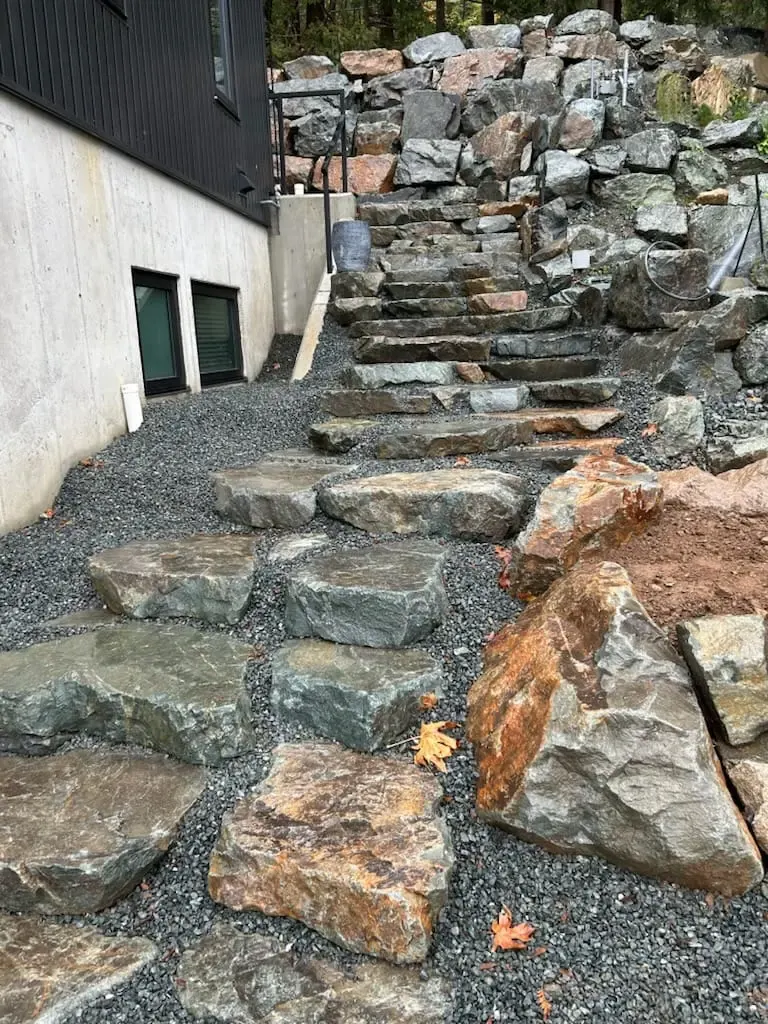
Retaining walls
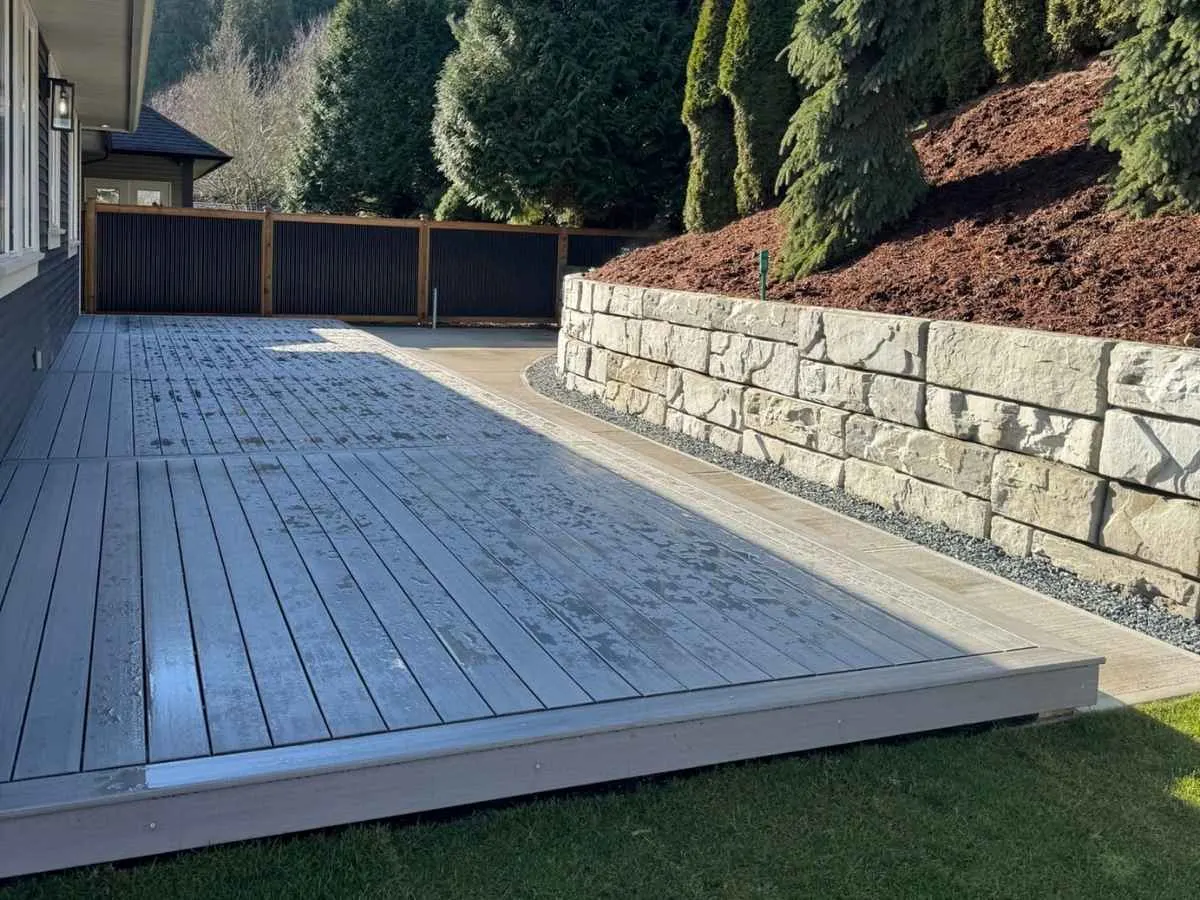
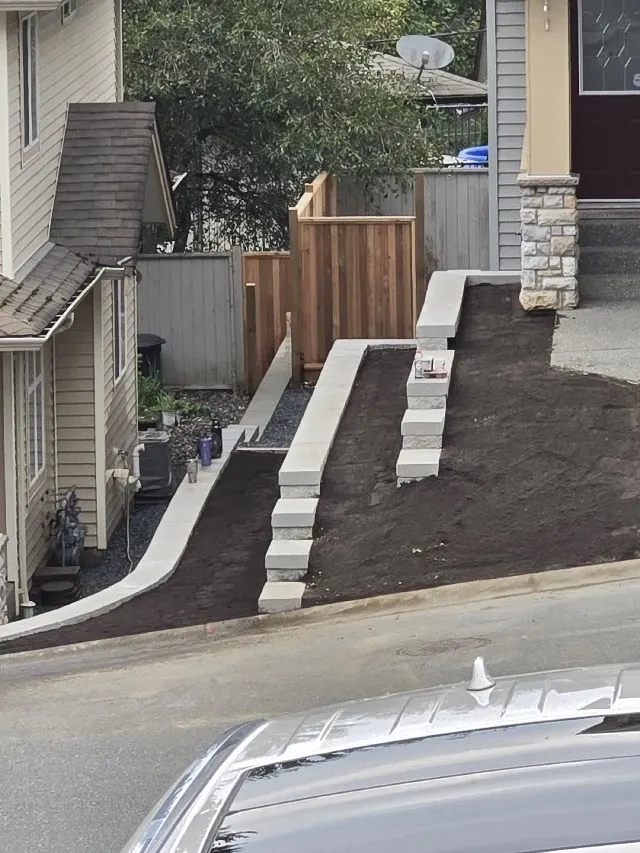
Rock and block walls for slopes, driveways and terraces, plus rebuilds of walls that have moved.
Learn more →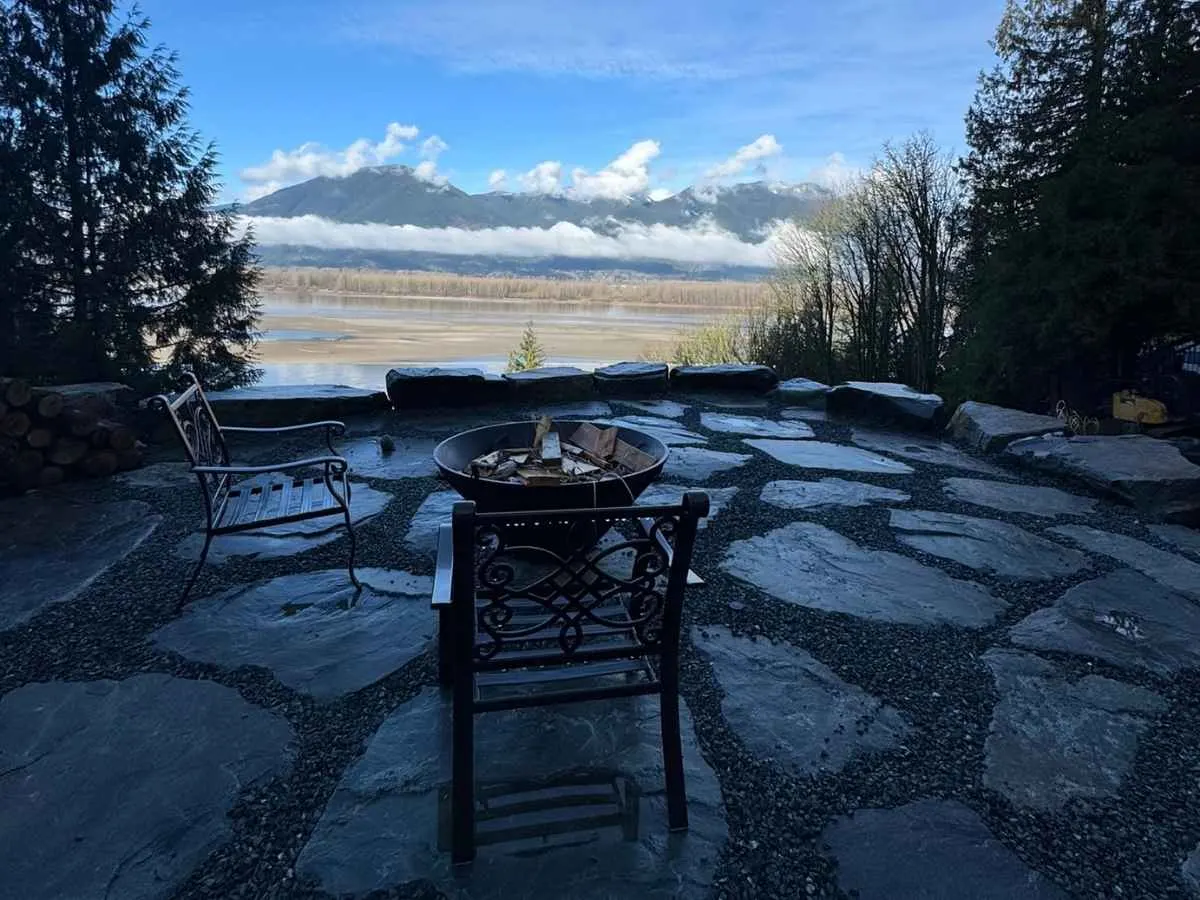
Retaining walls, patios, walkways, driveways and stonework. The hard surfaces that decide how a yard actually gets used.
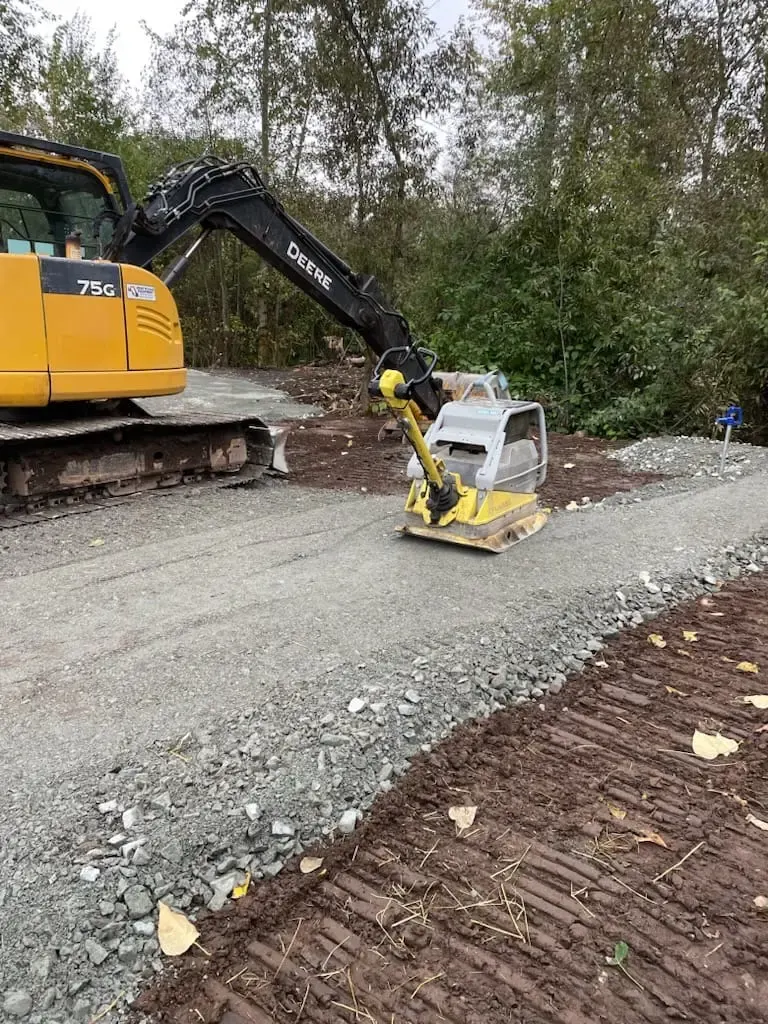
Everything built out of stone, block or paver. All of it sits on a base we dig and compact first.
Rock and block walls for slopes, driveways and terraces, plus rebuilds of walls that have moved.
Learn more →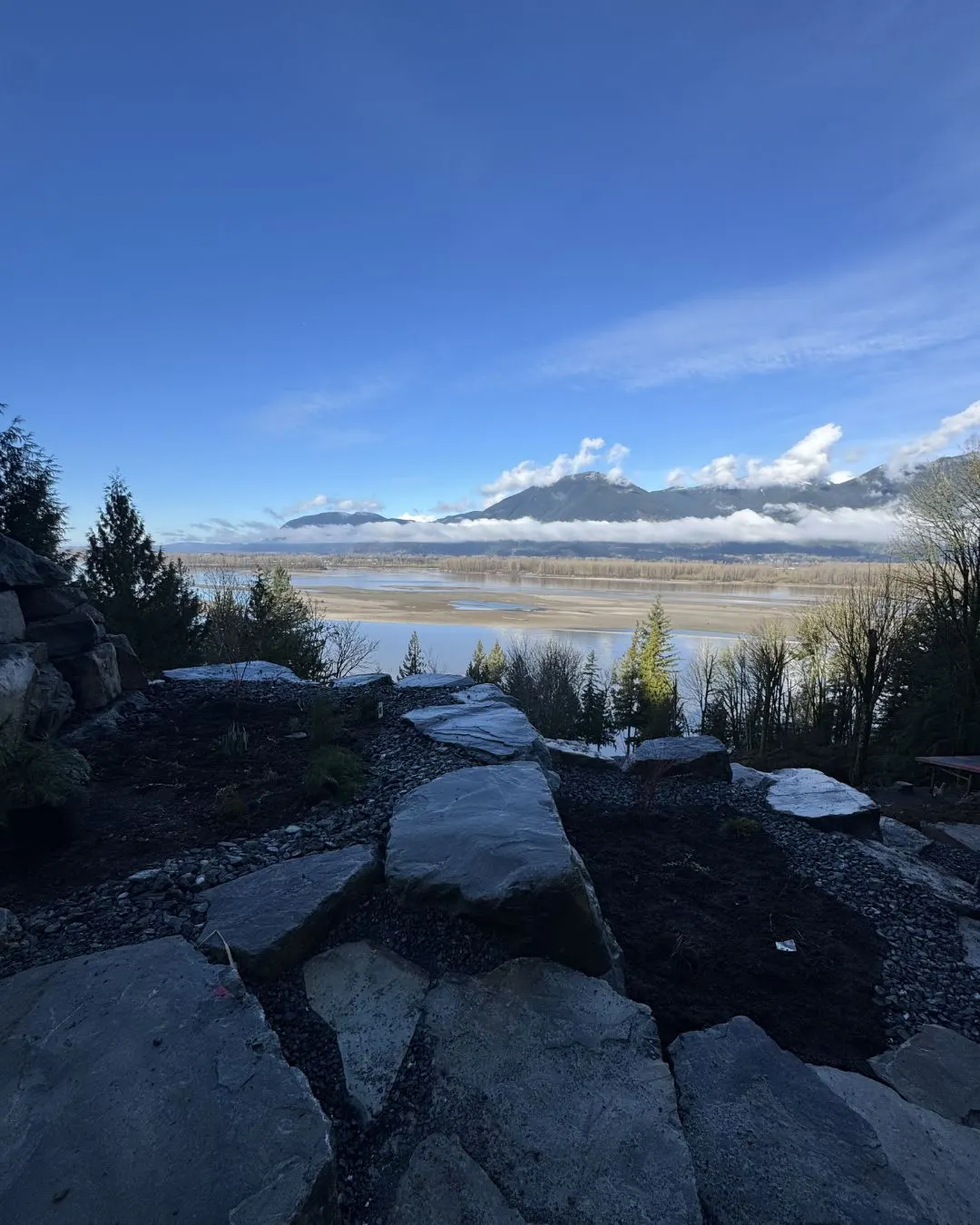
Paver and flagstone patios set on a compacted base, so they stay flat instead of sinking.
Learn more →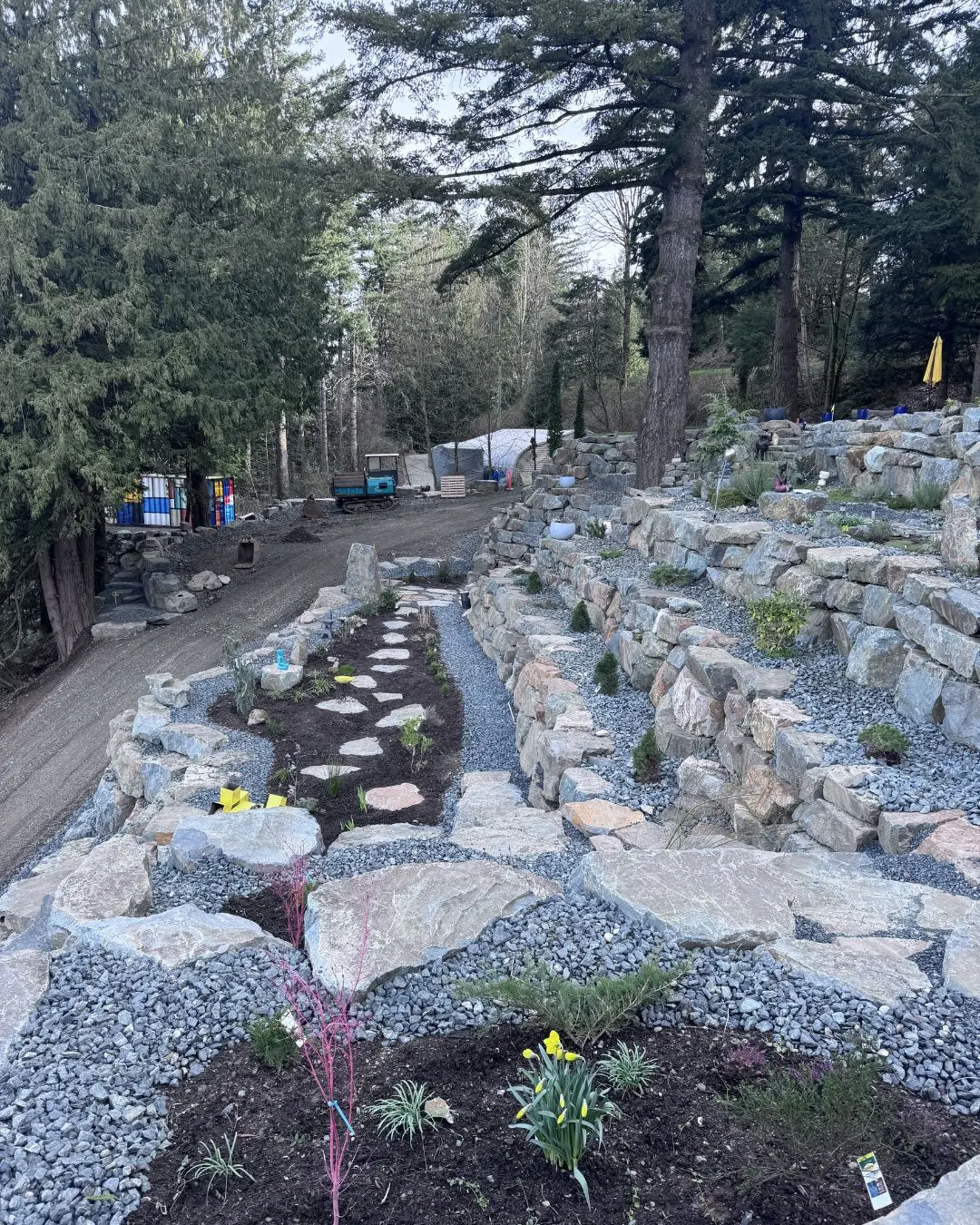
Connections between the house, the yard and the levels in between, built to the same base spec.
Learn more →
Driveways built to carry vehicle loads without rutting, dipping or spreading at the edges.
Learn more →A patio that sinks, a walkway that heaves and a driveway that ruts all have the same cause. The base under them was too thin, not compacted, or laid on ground that holds water.
We dig, compact and drain before anything gets set on top, because that is the part that decides how long the surface lasts.
Built from the base up.
Three steps from the first call to a finished surface.
Tell us about the space and how you want to use it, and we will set up a time to come out.
We measure the area, then you get a quote with the full scope.
One crew takes the job from the first dig to the final cleanup.
A paver surface distributes load through a compacted granular base rather than through the units themselves. The base spreads a point load across a wide bearing area. The bedding course provides a setting surface. Joint sand transfers load laterally between adjacent units, which is what converts individual pavers into an interlocking field. Edge restraint holds that field against the horizontal force the interlock generates. Surface gradient decides whether water leaves. Every common failure traces to one of those five elements rather than to the paving material.
Five layers sit between native ground and the finished surface, and each carries a distinct function.
Base depth scales with load class. Pedestrian patios commonly run 150 to 200 millimetres of compacted base. Driveways carrying vehicles commonly run 300 millimetres or more. Soft or clay subgrade increases the requirement regardless of what crosses the surface.
Interlocking paving transfers load horizontally as well as vertically. Each unit pushes against its neighbours, and that force accumulates outward toward the perimeter. An unrestrained edge creeps.
Creep opens joints progressively from the perimeter inward. The field loses interlock, individual units begin to rock, and the surface degrades from the edges rather than from the centre. The symptom appears years after installation.
Mechanical edge restraint, spiked into the compacted base at regular intervals, contains the field while remaining reversible. Concrete haunching along a driveway edge provides greater rigidity and permanently fixes the perimeter.
A soldier course, laid perpendicular to the field along the border, adds visual definition and distributes edge load across a wider unit face. The soldier course supplements restraint rather than replacing it.
Joint sand transfers load between adjacent units. A joint left empty converts an interlocking field into a collection of independent pavers, each carrying load alone.
Polymeric sand binds on activation with water, resists weed growth and reduces washout. The material remains a joint filler rather than a structural element. Ultraviolet exposure and traffic degrade it, and joints require periodic refill.
Washed joint sand permits easier lifting and resetting, which is one of the practical advantages segmental paving holds over poured surfaces. Practitioners trade weed resistance against reversibility when choosing between the two.
Surface gradient commonly targets around two percent away from structures. A level patio holds water. Minor settlement, which occurs on every surface, then creates low points that pond. Fall set during construction prevents that outcome for the life of the surface.
A driveway carries repeated vehicle loads in the same wheel tracks. A patio carries foot traffic distributed across the field. The two require different base thickness, and specifying one for the other produces either rutting or wasted cost.
Horizontal force accumulates toward the perimeter. Restraint contains it. Without containment the field creeps outward and joints open progressively from the edges inward.
Filled joints distribute a load applied to one paver across its neighbours. Empty joints isolate each unit. Interlock, not unit strength, gives segmental paving its load capacity.
Fall set during construction governs drainage behaviour permanently. Correcting gradient afterwards requires lifting the surface, removing bedding, regrading the base and relaying.
Segmental paving accommodates access for services, localised repair and ground movement. Individual units lift and return. Poured surfaces crack rather than move, and repair means removal and replacement of a whole section.
Misconception: Pavers Sit On A Sand Bed Alone.
A compacted granular base carries the load. The bedding layer above it, commonly 25 millimetres of washed chip or sand, provides a setting surface only. Pavers laid directly on sand over native soil settle under load and separate at the joints.
Misconception: A Deeper Base Always Performs Better.
Base depth matches load class and subgrade condition. Excess depth adds excavation, material and haulage cost without improving performance. Compaction quality across each lift determines outcome more reliably than total thickness does.
Misconception: Polymeric Sand Makes A Surface Permanent.
Polymeric sand binds joints, resists weed growth and reduces washout. The material remains a joint filler. It carries no structural load, degrades under ultraviolet exposure and traffic, and requires periodic replacement.
Misconception: Sealing Prevents Pavers From Sinking.
Sealing treats the surface. Settlement originates in the base and the subgrade. A sealed surface over an inadequate base settles on the same schedule as an unsealed one.
Misconception: A Patio Should Be Perfectly Level.
A level surface holds water. Paved areas carry a deliberate gradient, commonly around two percent away from structures, so water runs off rather than ponding at low points created by minor settlement.
Open graded against dense graded base. Open graded advocates cite drainage through the base and reduced frost susceptibility. Dense graded advocates cite higher density and more predictable load spread.
Polymeric against washed joint sand. Polymeric resists weeds and washout. Washed sand permits straightforward lifting and resetting, which preserves one of the main advantages of segmental paving.
Concrete haunch against mechanical restraint on driveways. Haunching delivers rigidity under vehicle load. Mechanical restraint stays reversible and does not crack.
Bedding thickness. Thinner beds reduce the settlement available within the layer. Thicker beds ease screeding tolerance across uneven base. The trade runs between finish accuracy and long term movement.
Sealing. One position cites stain resistance and colour enhancement. The other cites the ongoing reapplication commitment and reduced wet slip resistance on some products.
A paved surface performs through its base rather than its units. Compacted granular base spreads load, bedding sets the units, joint sand creates interlock, and edge restraint contains the horizontal force that interlock generates. Gradient decides where water goes. Sinking reports a base fault, spreading reports an edge fault, and ponding reports a gradient fault. Material choice changes appearance and installation method. The five elements beneath determine how long the surface holds its line.
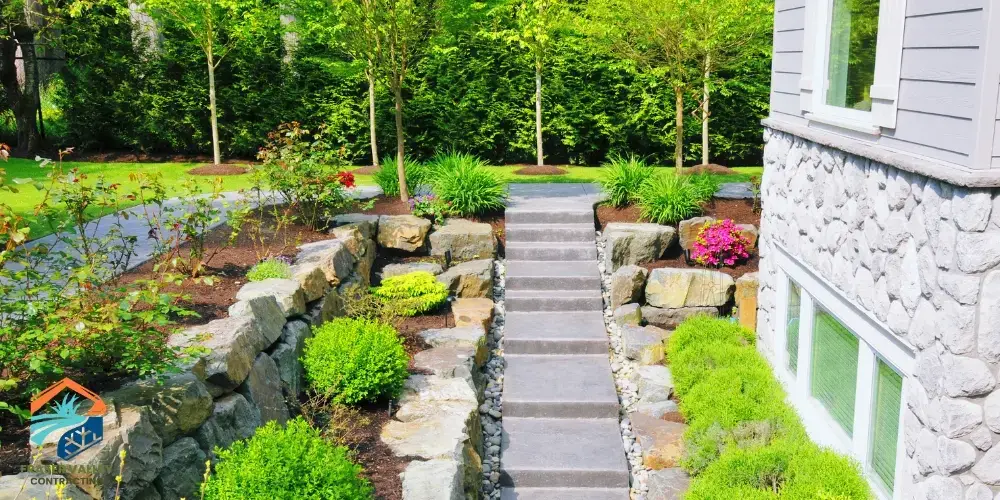
Hardscaping refers to the non-organic parts of your landscape such as driveways, walkways, patios, retaining walls, and steps. In the Fraser Valley, hardscaping isn’t...
Read the guide →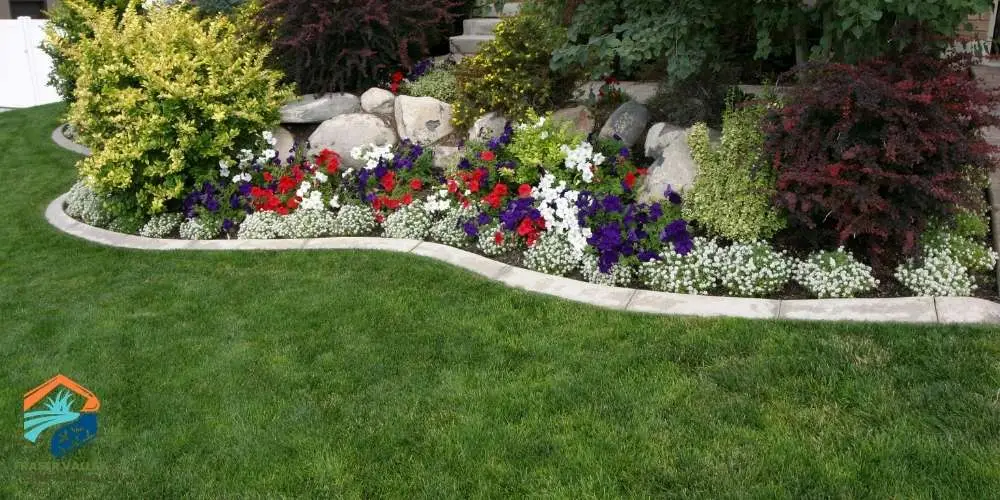
A well-designed backyard can become one of the most enjoyable and valuable parts of your home. While plants, lawns, and gardens add beauty, it’s often the hardscape...
Read the guide →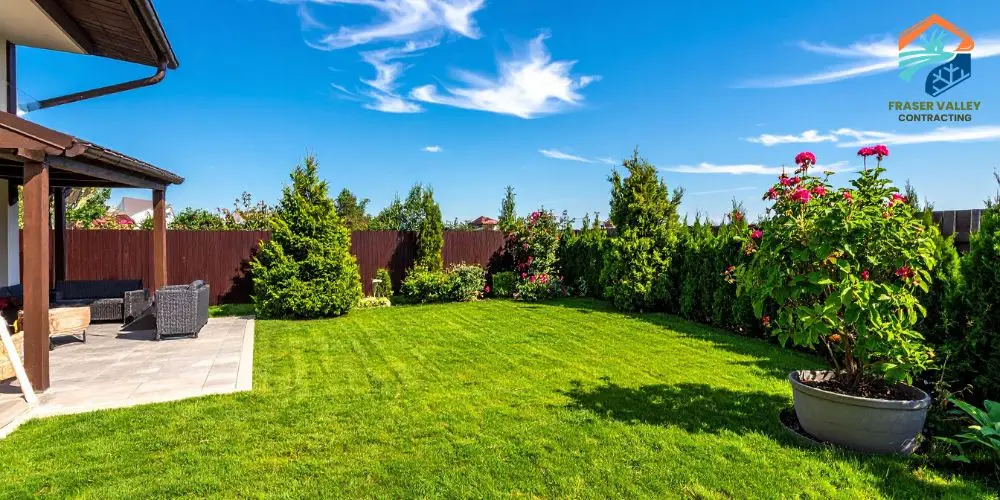
There’s something about stepping into a well-designed backyard that just feels right. It’s not only about greenery anymore—it’s about structure, flow, and creating a...
Read the guide →Great company 5/5. Owen and team are honest and hard working.
We always use them for our jobs. Easy to work with and very reliable.
We have hired this crew for various projects on our acreage. The latest project was an equestrian riding arena, which turned out excellent. They are always willing to take on tasks and challenges with great outcome. Their operators and labourers are hard-working and willing to put in the time to get a job done.
Hardscaping is everything built from stone, block, paver or concrete. Landscaping is the soft finish on top, the sod, turf and planting. We do both, and on most projects the hardscaping goes in first.
Most residential surfaces run between a few days and a couple of weeks, depending on size, access and how much excavation sits underneath. The quote gives you the scope and the sequence.
Yes, and it is most of what we do. A sloped yard usually means walls, steps and terracing before any flat surface can exist, which is why the excavation and the hardscaping sit with one crew.
Based in Chilliwack, working with homeowners and businesses from Langley through to Hope.
Not sure if we cover your area? Call (604) 703-8315 and we will tell you right away.
Give us a call or fill out the form. We will visit your property within the week, take a look and give you a free estimate.