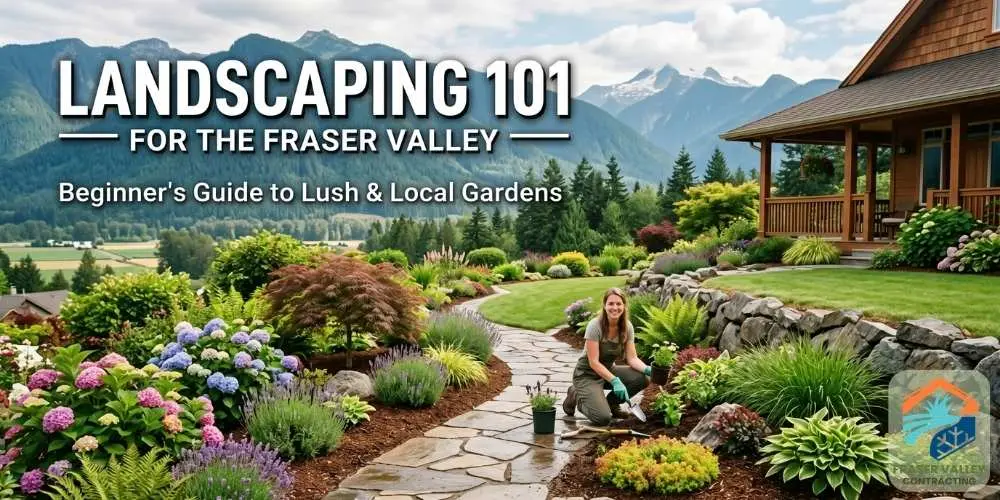
The Fraser Valley landscaping guide that starts below the surface
Everything a Chilliwack or Fraser Valley homeowner should know before reshaping a yard — clay soil, drainage, hardscaping, lawns, watering rules, the right plants, and the invasive ones worth fearing.
Region: Chilliwack & the Fraser Valley. Hardiness: Zone 7–8. Read: about 15 minutes.
Most landscaping advice online is written for somewhere else — a dry climate, a sandy lot, a flat suburban grid. The Fraser Valley is its own animal. We sit on a floodplain hemmed in by mountains, on heavy clay soil, under some of the wettest skies in the country for half the year, then bake through an increasingly dry, restriction-heavy summer. A yard that was designed for “pretty on day one” tends to fall apart here by the second winter.
This guide is the plain-language version of what our crews think about on every job. It will not turn you into a contractor, but it will help you make smarter decisions, ask better questions, and avoid the expensive mistakes we get called in to fix — sinking pavers, leaning walls, lawns that drown in November and fry in August. Wherever a job genuinely calls for excavation, grading, or structural work, we’ll say so honestly.
Know your ground before you spend a dollar
Good landscaping is local. The single biggest reason out-of-the-box plans fail in Chilliwack is that they ignore three facts about where we live.
We’re in hardiness Zone 7–8
The City of Chilliwack puts the area in plant hardiness Zone 7–8. In practical terms that’s a mild, temperate, coastal-influenced climate with a long growing season — roughly March through November — and winters that rarely stay deeply frozen. That’s a gift: it opens up a huge range of plants. But “mild and wet” is exactly what fungal disease, moss, root rot, and aggressive weeds love too, so the climate that lets you grow almost anything also punishes poor drainage faster than a colder, drier region would.
Our soil is mostly clay
Across much of the Valley floor, the topsoil sits over heavy, clay-rich ground. Clay is not “bad” soil — it holds nutrients well — but it drains slowly. Light clay will eventually let water pass; heavy clay can hold it on the surface almost indefinitely, which is why so many local backyards turn to soup after a single day of rain and stay that way. Healthy, deep-rooted grass and plants are part of what helps water work its way down through clay; bare, compacted ground makes the problem permanent.
We get a lot of rain — in bursts
The Valley funnels weather between the coast and the mountains. Fall and winter bring long, heavy rain events; spring can dump 100 mm-plus in a stretch, with soil saturation, erosion, and localized flooding a real concern in low-lying and riverside pockets. Then summer flips: hot, dry, and governed by watering restrictions. Designing for both extremes — not just the sunny photo — is the whole game.
“Where will the water go in a heavy November rain?” is the first question worth asking about any yard project — long before plants, pavers, or budget.
It always comes back to water
If you remember one thing from this guide, make it this: in the Fraser Valley, drainage is the foundation of everything else. The prettiest patio, the lushest lawn, the boldest retaining wall — all of them fail early if water has nowhere good to go. Most of the outdoor problems we get called to fix trace back to water and weak prep, not to the visible feature itself.
Start with grade
“Grading” just means shaping the ground so water moves where you want it — generally away from your house, patios, and foundations, and toward a safe outlet. A surprising number of drainage complaints are solved not by fancy systems but by correcting a yard that quietly slopes the wrong way. Proper site grading is cheap insurance compared to a flooded crawlspace.
When grade isn’t enough
On heavy clay, regrading alone sometimes can’t move water fast enough. That’s where engineered drainage comes in — French drains (gravel-bedded perforated pipe), catch basins, and proper discharge points sized to actually carry our rainfall. A note from experience: the cheap thin-wall pipe sold everywhere in the Valley clogs and crushes in clay surprisingly fast. Drainage is one place where the right materials and slope matter more than the price tag, because redoing a buried system means digging the yard up twice.
This is our home turf
Grading, drainage, and excavation are core to what we do — and we handle them as one connected build rather than three disconnected trades. That’s how water flow, base prep, and finished surfaces actually line up.
Explore site prep & drainage →
Retaining walls do double duty
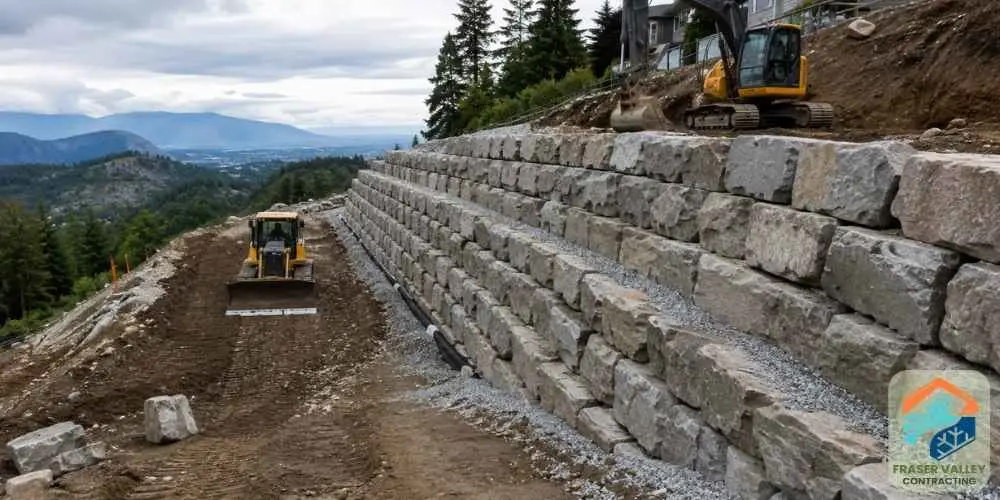
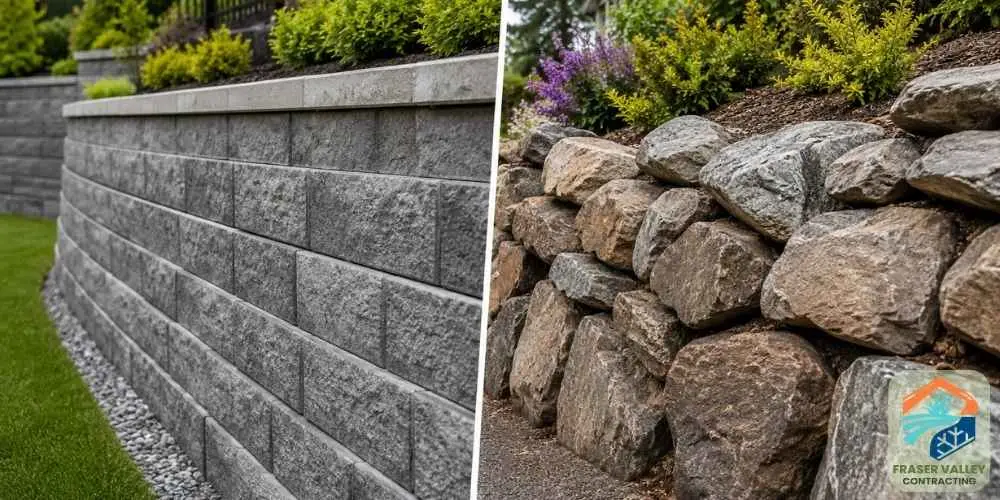
On a sloped or shifting lot — common across Chilliwack, the benchlands, and rural Agassiz and Hope — a retaining wall isn’t just landscaping decoration. It holds back soil, creates usable flat space, and, when built correctly, manages the water moving through that slope. A retaining wall without proper drainage behind it (gravel backfill, weep holes, drain pipe) is a wall on a countdown timer: hydrostatic pressure from trapped water is what makes walls bulge, crack, and lean.
Building the bones: hardscaping done right
Hardscaping is the hard, permanent structure of a yard — patios, walkways, steps, driveways, walls, stone features. Done well, it’s the part of your landscape that should outlive almost everything else. Done badly, it’s the part that fails most visibly and most expensively. The difference is almost always invisible: it’s the base.
It’s all about the base (and compaction)
Pavers and slabs don’t sink because the pavers are bad. They sink because the ground underneath wasn’t excavated deep enough, the base material wasn’t the right depth, or it wasn’t compacted in proper lifts. On our clay, that prep work — dig out, install and compact a road-base, set the bedding, then lay the surface — is the entire ballgame. A patio is only ever as good as the few inches you can’t see.
Patios & Pavers
The outdoor living anchor. Needs depth, the right base, edge restraint, and a slight slope to shed water — never trapping it against the house.
Walkways & Steps
Safety and flow. Consistent risers and stable, well-drained footing matter most through wet Valley winters.
Driveways
The heaviest-loaded surface on your property. Base prep here is non-negotiable; rushed compaction shows up as ruts and cracks fast.
Retaining Walls
Structure plus water management. Drainage behind the wall is what keeps it standing straight for decades.
Natural Stonework
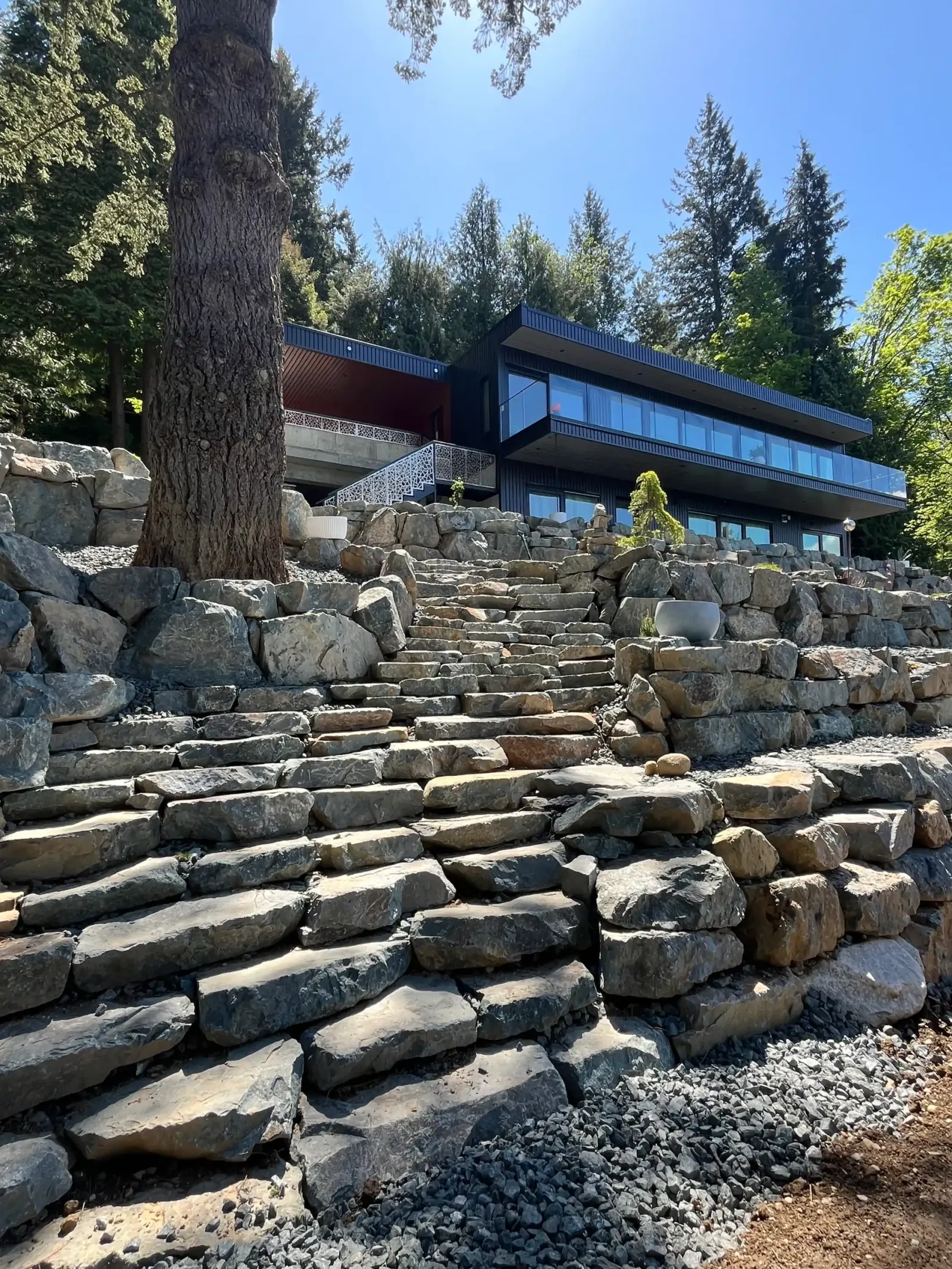
High-end, timeless finishes — steps, veneers, features — that reward precision and patience.
Raised Beds & Borders
A clay-soil hero: build up instead of fighting down, with clean definition and controlled, draining soil.
One more hard-won lesson: the more crews involved, the more places a project can fail. When excavation, base prep, grading, and the finished hardscape are split between separate contractors, the seams between them are where settling, pooling, and finger-pointing live. Keeping the full build under one crew and one standard is the most reliable way to make everything fit, drain, and hold up together.
Lawns that survive a Fraser Valley summer
A good lawn here has to live two lives: a soggy one and a thirsty one. Here’s how to set one up for both.
Sod, seed, or turf?
Sod gives you an instant, finished lawn and is the most popular choice for a fresh install — the catch is that it’s only as good as the soil and grading underneath, so prep comes first. Seed is cheaper but slower and needs careful timing (early fall is ideal in our climate; spring also works). Artificial turf has earned its place for high-traffic spots, deep shade where grass refuses to grow, pet areas, and anyone who simply doesn’t want to fight summer restrictions — though it still needs a properly draining base to avoid puddling. We install both sod and turf depending on what the space actually needs.
The maintenance that actually matters
The City of Chilliwack’s own natural-yard-care guidance lines up with what keeps lawns healthy here:
- Mow high. Longer grass shades out weeds and grows deeper, more drought-resistant roots.
- Leave the clippings (“grasscycling”). Free nitrogen, less waste.
- Overseed in spring and aerate to relieve compaction — critical on clay.
- Top-dress with a thin layer of fine compost to feed the soil.
- Don’t overwater. Most lawns need only about 2.5 cm (1 inch) of water per week, rain included. Overwatering builds weak, shallow roots.
Know the watering rules — they’re stricter than people think
Summer water restrictions are a fact of life here, and lawn watering accounts for roughly 30% of Chilliwack’s summer water use. The rules differ by city and can escalate stage-by-stage in a dry year, so always confirm the current stage with your municipality. As a general picture for a typical recent season:
| City | Season | Even addresses | Odd addresses |
|---|---|---|---|
| Chilliwack | ~May 1 – Oct 15 | Wed & Sat, 5–8 am or 7–10 pm | Thu & Sun, 5–8 am or 7–10 pm |
| Abbotsford (FVRD) | From ~May 1 | Sat, early-morning window | Sun, early-morning window |
Hand-watering with a shut-off nozzle, soaker hoses, and drip irrigation are generally allowed more freely than sprinklers, and brand-new lawns can often get a short-term exemption certificate while they establish. Two more things worth knowing: a golden, dormant summer lawn is normal and healthy — it greens back up with the fall rain (Chilliwack even runs a friendly contest for it) — and in BC, strata corporations generally can’t fine owners for a brown lawn during active water restrictions.
Want the deeper lawn playbook?
We’ve written a Chilliwack-specific spring lawn-care walkthrough that goes further on timing, aeration, and recovery.
Read: Lawn Care in Chilliwack →
Planting smart for Zone 7–8
The easiest yard to maintain is one planted with species that already want to live here. Native and well-adapted plants need less water, shrug off local pests, and feed the birds, bees, and butterflies that keep a garden healthy. As summers trend hotter and drier, xeriscaping — designing for low water use with drought-tolerant planting, mulch, and efficient irrigation — is becoming the smart default, not a fringe choice.
Reliable Fraser Valley natives
Tall Oregon-Grape (Mahonia aquifolium)
Evergreen, holly-like leaves, yellow spring flowers feeding early pollinators, blue berries after. Tough and unfussy. Light: Sun / Part Sun.
Red-Flowering Currant (Ribes sanguineum)
Spring red blooms that hummingbirds and bees love; birds take the seeds. A Valley classic. Light: Sun.
Salal (Gaultheria shallon)
Glossy evergreen groundcover-to-shrub, happy in shade, edible berries. Excellent woodland filler. Light: Shade.
Western Sword Fern (Polystichum munitum)
Iconic evergreen fern for damp or dry shade. Near-zero maintenance once rooted. Light: Shade.
Kinnikinnick (Arctostaphylos uva-ursi)
Mat-forming evergreen groundcover with flowers and berries. Drought-tolerant once established. Light: Sun.
Common Snowberry (Symphoricarpos albus)
Hardy shrub with white winter berries for interest and wildlife. Handles tough spots. Light: Sun / Part Sun.
Vine Maple (Acer circinatum)
Graceful native maple with brilliant fall colour; shelter and structure for the garden. Light: Sun / Part Sun.
Western Redcedar (Thuja plicata)
BC’s official tree — a stately evergreen for larger lots, screening, and wildlife. Give it room. Light: Part Sun.
A few simple planting rules for here
- Mix it up. Gardens with 10+ plant species attract the most pollinators. Stagger bloom times so there’s food from early spring through late summer.
- Build raised beds on clay. Rather than fighting heavy soil, raised beds and borders give you control over drainage and soil quality.
- Mulch. It holds moisture through dry spells, suppresses weeds, and slowly improves the soil.
- Water the first year, then back off. Even drought-tolerant natives need regular water until established — usually one growing season.
- Check the Latin name. Many “native” nursery plants are look-alike imports; the botanical name confirms you’re getting the real thing.
The invaders: blackberry, knotweed & ivy
The Fraser Valley is one of the most invasive-plant-pressured regions in the province. These species don’t just look messy — they crowd out everything else, damage structures, lower property usability, and in some cases are genuinely difficult and hazardous to remove. Knowing what you’re looking at changes how you deal with it.
Himalayan blackberry
The thorny thicket everyone recognizes. It spreads viciously — a single square metre of canes can drop 7,000 to 13,000 seeds, canes reach several metres, and it will swallow a fence line, slope, or back corner in a couple of seasons. Hand-pulling rarely wins because it regrows from the crown and root fragments. Effective removal usually means machine clearing the canes and digging out the root mass, then staying on top of regrowth. This is exactly the kind of overgrown-property reset our brush and blackberry clearing handles.
⚠ Knotweed: do not DIY this one
Japanese, Bohemian, Giant, and Himalayan knotweed all grow in the Valley, and they are in a different league. The bamboo-like canes grow from a root system that can reach ~20 m sideways and 3 m deep, and a fragment as small as 1 cm can start a whole new colony. It can push through asphalt and foundations. Cutting or rototilling it — or moving the soil — typically spreads it and makes the problem worse. It can’t go in compost or yard waste; it has to be bagged and landfilled. Authorities recommend a managed approach, often involving herbicide treatment over time. If you think you have knotweed, identify it carefully before touching it and get professional advice.
English ivy, periwinkle & the quiet creepers
Less dramatic but still destructive: English ivy and periwinkle form dense carpets that smother native groundcover and climb (and damage) trees and walls. Scotch broom, giant hogweed (toxic — its sap causes severe burns; never cut it casually), English holly, and lamium round out the usual Valley suspects. Some municipalities can fine for letting listed invasives spread.
Overgrown lot? Start with a clean slate.
Fast, machine-based brush and blackberry clearing opens up a reclaimed corner, an overgrown fence line, or a whole neglected property — and sets the stage for proper grading and a fresh build.
See site prep, clearing & excavation →
A Fraser Valley landscaping calendar
Timing is half of landscaping success here. A rough rhythm for the year:
Spring, Mar to May
- Overseed & aerate the lawn
- Top-dress with compost
- Best window for planting and new sod
- Tackle blackberry & weeds before they explode
- Plan hardscaping before the busy season
Summer, Jun to Aug
- Follow watering restrictions — check your stage
- Mow high; let the lawn go golden if needed
- Deep, infrequent watering for plants
- Prime, dry season for excavation & builds
- Mulch to hold moisture
Fall, Sep to Nov
- Top time to plant trees & shrubs
- Overseed; lawns recover with the rain
- Test drainage in the first big storms
- Fix grading & drains before deep winter
- Clear leaves off drains and catch basins
Winter, Dec to Feb
- Watch where water pools & ice forms
- Note problem spots for spring fixes
- Plan and quote next year’s projects
- Prune dormant deciduous trees
- Keep walkways safe and draining
Tip: the smartest time to diagnose a drainage problem is during a heavy fall storm, when you can actually see where the water goes. The smartest time to fix it is the following dry season.
Landscaping & hardscaping where you live
Every community in the Valley has its own quirks — low-lying flood-prone pockets, benchland slopes, rural acreage, tight urban side-yards. We build for local conditions across the region:
Chilliwack
Drainage-first hardscaping for valley-corridor conditions — low spots, runoff, and ground movement included.
Abbotsford
Durable, drainage-conscious patios, walls, and walkways for the Valley’s largest city.
Agassiz
Rural and sloped properties where grading, erosion control, and solid base prep matter most.
Hope
Stable groundwork for changing terrain — the right excavation, grading, and drainage from the start.
Outside these towns? We serve surrounding Fraser Valley communities too — reach out with your address and a couple of photos to confirm availability.
One crew, from site prep to finish
Whether you’re fixing a soggy yard, holding back a slope, or building the backyard from scratch — we handle excavation, grading, drainage, and the finished hardscape as one connected build, so everything fits, drains, and holds up.
Request a Quote Explore our servicesFrequently asked questions
Why does my Fraser Valley yard flood or stay soggy?
Usually a combination of heavy clay soil that drains slowly and a grade that doesn’t move water away from the low spots. The fix is rarely just “more topsoil” — it’s correcting the slope and, where needed, adding properly sized drainage with a real outlet. Diagnosing it during a heavy storm is the most reliable way to see what’s actually happening.
Should I get sod, grass seed, or artificial turf?
Sod gives an instant lawn and is the most common choice for a fresh install; seed is cheaper but slower and timing-sensitive; artificial turf suits high-traffic areas, deep shade, pet zones, and anyone tired of summer restrictions. All three depend on proper soil prep and drainage underneath — that’s the part that determines whether they last.
When can I water my lawn in Chilliwack?
During summer restrictions, sprinkler use is limited to set days and time windows by address (and the rules differ in Abbotsford and other FVRD communities). Stages can tighten in a dry year, so always check the current stage with your city. Hand-watering, soaker hoses, and drip are generally allowed more freely, and most lawns only need about an inch of water a week.
I think I have knotweed. What do I do?
Don’t cut, dig, or rototill it, and don’t move the soil — that tends to spread it. It regrows from tiny fragments and can’t go in compost or yard waste. Confirm the identification, leave it in place for now, and get professional advice on a managed removal approach. It’s one of the few yard problems where DIY usually makes things worse.
Do you handle the whole project, or just one part?
We handle the full outdoor build under one crew — excavation and site prep, grading and drainage, then the finished hardscaping and sod or turf. Keeping it all in one scope is how we avoid the settling, pooling, and finger-pointing that happen when work is split across multiple trades. Request a quote to talk through your project.
Trusted local resources & further reading
- City of Chilliwack — Natural Yard Care & Summer Watering Restrictions (chilliwack.com/water)
- Fraser Valley Conservancy — Gardening with Native Plants in the Lower Mainland and Fraser Valley
- Fraser Valley Invasive Species Society (FVISS) — invasive plant identification & advice
- Invasive Species Council of BC (bcinvasives.ca) — provincial identification & management
- Metro Vancouver Grow Green & UBC Botanical Garden — eco-friendly garden plant guides
This guide is general educational information for Fraser Valley homeowners. Watering restriction stages, days, and times change by season and municipality — always confirm current rules with your city before relying on them.